

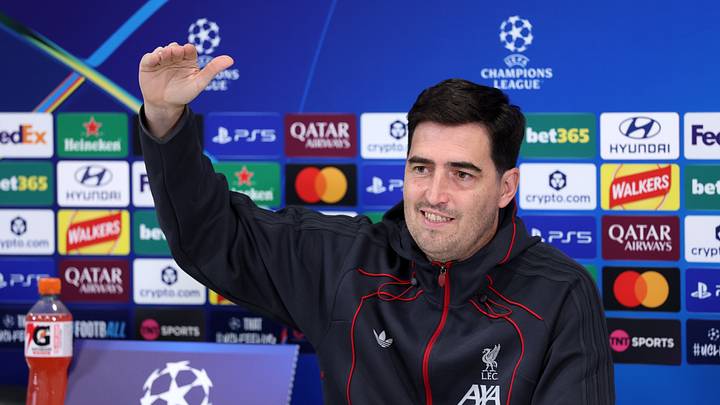
Andoni Iraola will experience a new feeling tonight.
When Liverpool walk out at Anfield to face Atlético Madrid, the Spaniard will take charge of his first-ever Champions League game as a manager.
It is a significant moment in a career that has already taken him from Rayo Vallecano to Bournemouth and now to one of European football’s biggest stages.
Yet Iraola is far from the first Spaniard to leave his mark on Liverpool’s Champions League history.
From Rafa Benítez’s Istanbul triumph to Xabi Alonso’s unforgettable equaliser, Spanish influence runs through some of Liverpool’s most memorable European nights.
Rafa Benítez (2004-2010)
Few Spaniards have had a greater impact on Liverpool than Rafa Benítez. Arriving at Anfield in 2004, the Spaniard immediately brought his tactical identity to Merseyside and guided Liverpool to one of the greatest Champions League triumphs of all time in Istanbul in 2005.
Two years later, Benítez had Liverpool back in the final, this time losing 2-1 to AC Milan in Athens.
Iraola now becomes the latest Spanish coach to lead a Premier League side into the Champions League, following Pep Guardiola and Mikel Arteta, while Unai Emery has also enjoyed European success with Aston Villa.
Xabi Alonso (2004-2009)
Xabi Alonso did not need long to announce himself at Liverpool.
The midfielder arrived from Real Sociedad in the summer of 2004 and, in his very first season at Anfield, found himself playing in a Champions League final.
Trailing AC Milan 3-0 at half-time, Liverpool produced the greatest comeback in the competition’s history. Alonso was central to the revival, following up a saved penalty to score the equaliser Liverpool needed to push the game into extra-time.
His first season ended with European glory, while Alonso remained a crucial figure as Benítez’s Liverpool reached another final in 2007.
Iraola could hardly ask for a better Spanish example to follow.
Luis García (2004-2007)
If Alonso represented the composure of Benítez’s midfield, Luis García represented something altogether more unpredictable.
The forward was another key member of the 2005 Champions League-winning squad and played a pivotal role throughout Liverpool’s remarkable run.
García scored five times during the campaign, repeatedly appearing when Liverpool needed him most. He struck three times across the two legs against Bayer Leverkusen in the last 16 before scoring in the 2-1 quarter-final victory over Juventus.
His famous “Ghost Goal” against Chelsea in the semi-final second leg at Anfield sent Liverpool into the final and became one of the defining moments of the entire campaign.
Spanish influence was not peripheral to that Liverpool team - it was everywhere.
Álvaro Arbeloa (2007-2009)
Álvaro Arbeloa arrived at Liverpool in January 2007 from Deportivo La Coruña, but Benítez wasted little time giving his new signing one of the biggest tests imaginable.
On his Liverpool debut, Arbeloa was tasked with dealing with a young Lionel Messi at the Camp Nou.
Liverpool emerged with a 2-1 victory over Barcelona, putting themselves in an excellent position to reach another Champions League final. Arbeloa’s ability to perform such a difficult defensive assignment immediately demonstrated the trust Benítez placed in him.
Fernando Torres (2007-2011)
Then came Torres.
The Spaniard arrived from Atlético Madrid in 2007 and produced one of the greatest debut seasons in Liverpool’s modern history, scoring 33 goals in all competitions.
His impact was particularly evident in Europe. Torres scored against Inter Milan in the last 16, Arsenal in the quarter-final and Chelsea in the semi-final, as Liverpool reached the last four of the 2007/08 Champions League.
Now it is Iraola’s turn
That is what makes tonight particularly fascinating.
Iraola is not simply making his Champions League debut as a manager. He is stepping into a club whose modern European history has been shaped by Spaniards.
And now Iraola gets his first taste.
Spanish managers have increasingly shaped the Premier League, from Guardiola and Arteta to Emery, and Iraola has already established himself as one of the country’s most exciting coaches.
Now, at Anfield, against one of Spain’s most influential clubs no less, he has the opportunity to add his own chapter to Liverpool’s remarkable Spanish history.
 Add us as a preferred source on Google