

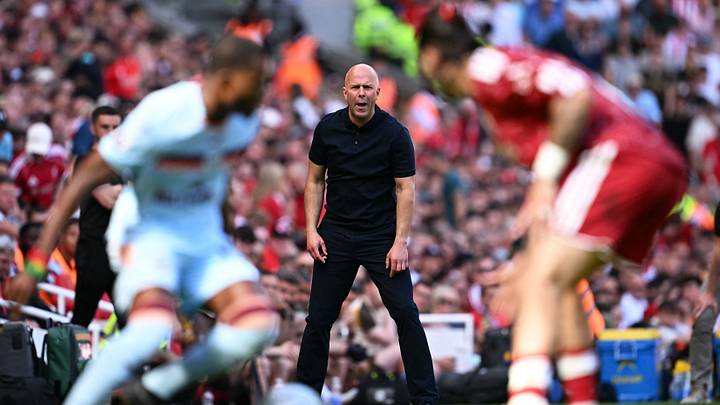
Liverpool’s 2025/26 season came to a close on Sunday with a 1-1 draw against Brentford, and judging by the mood around the fanbase, most supporters are relieved to finally see the curtain fall on a deeply frustrating campaign.
This season delivered surprises in all the wrong ways — most notably through Liverpool’s shockingly weak title defense — but amid the disappointment, there were still a handful of unexpected positives the club can carry into next year.
From breakout talents to worrying regressions from established stars, the campaign produced no shortage of developments that few could have predicted back in August.
So, with a painful season now officially in the books, let’s take a look back at the good, the bad, and the downright ugly surprises that defined Liverpool’s 2025/26 campaign.
Good surprises: The play of Dominik Szoboszlai and Hugo Ekitike
While there were clearly plenty of players who fell well short of the level required for Liverpool to repeat as champions, both Szoboszlai and Ekitike emerged as crucial figures who continued to fight for the badge every week and ultimately helped drag the Reds back into the Champions League.
I’ve been a fan of Szoboszlai’s game for a long time, but even with the high expectations I had for him entering this season, I still never imagined he would become Liverpool’s player of the season by such a wide margin.
He truly did everything for the Reds this year: scoring stunning free kicks, filling in at right-back when needed, and even shifting out to the wing, finding the net at Old Trafford when playing there.
Szoboszlai’s versatility and relentless engine became one of the few genuine sources of pride supporters could cling to during an otherwise brutal campaign.
In fact, with Virgil van Dijk entering the twilight of his Liverpool career, Szoboszlai’s refusal to ever coast through matches felt emblematic of future captaincy material. If he continues on this trajectory, it would not be surprising at all to see Liverpool’s No. 8 wear the armband one day.
Alongside Szoboszlai’s breakout campaign came another massive surprise: who realistically expected Hugo Ekitike to finish with 23 goal contributions in a debut season that could have been more if not cut short by a devastating injury?

With most of the attention centered around how Alexander Isak would fare after arriving for a British-record fee — and despite his own weak output, I’m still not ready to label him a bad surprise due to a lack of preseason and gruesome injury of his own — Ekitike quickly proved he was far more than simply “the backup option in case Isak didn’t arrive.”
Instead, he played like a striker determined to become Liverpool’s long-term No. 1.
Beyond his clinical finishing, Ekitike showcased tremendous quality on the ball, displaying the creativity to both score and create chances while possessing a level of dribbling flair more commonly associated with wide players.
Once he returns to full fitness, Liverpool simply have to find a way to make him a central part of their plans moving forward, even if Isak also finds his best form.
Given how quickly he became an Anfield favorite, it’s hard to imagine the club’s future without him playing a major role.
The bad surprises: Florian Wirtz's debut season and futility against Big Six clubs
While Isak at least had the excuse of lacking full fitness for much of the season, the same cannot be said for Florian Wirtz, who arrived at Anfield fresh off starring campaigns for both Bayer Leverkusen and the German national team.
With a massive price tag attached to his name, Wirtz was expected to immediately take control of Liverpool’s midfield and become one of the faces of a new era under Arne Slot. Instead, his debut campaign never truly got going.
The growing pains that often come with a first move to the Premier League caught up with the German in a major way, as too many matches seemed to pass him by with little influence on proceedings. At times, he simply looked overwhelmed by the speed and physicality of English football.
To be fair, there were flashes of the player Liverpool believed they were signing. A brief stretch in January — particularly during the Newcastle match when he and Hugo Ekitike caught fire together — offered a glimpse of what the duo could eventually become. Still, it often felt like Wirtz failed to deliver when the lights were brightest.
Goals against Wolves, Crystal Palace and Fulham were welcome, but too often Florian faded into the background during Liverpool’s marquee fixtures which was a problem that mirrored the team’s wider struggles against the Premier League’s elite.
With a meager seven points combined against Manchester City, Manchester United, Chelsea, Arsenal and Tottenham, Liverpool consistently failed to rise to the occasion in the matches that define status and credibility in English football.
At times, it almost felt as though the team itself no longer fully believed it belonged among the country’s elite.
That represented a dramatic shift from the previous season, when Liverpool swept City and routinely looked capable of competing with anyone in the league. This year, that aura completely disappeared.
If Liverpool are to climb back to the summit in 2026/27, rediscovering the belief that they can go toe-to-toe with England’s biggest clubs will have to be non-negotiable.

The ugly suprises: The dramatic regression of Mo Salah and Arne Slot
I got teary-eyed watching Mohamed Salah walk off the pitch for the final time as a Liverpool player on Sunday.
Across the eight or so years I’ve followed this club, Salah became my absolute favorite player, and I know countless Liverpool supporters feel exactly the same way.
But without dwelling too much on his untouchable legacy at Anfield, if we’re speaking strictly about this season, Salah’s overall performances were simply shocking.
What made the decline all the more surprising was that it did not feel like a natural regression. Had the 33 year-old shown signs of slowing down over the previous year or two, this season may have been easier to understand.
Instead, the Egyptian King entered the campaign fresh off equaling the Premier League single-season goal contribution record while also winning the league title, the Player of the Season award, the Golden Boot and the Playmaker Award.
The history books will genuinely struggle to explain how things unraveled so dramatically in his final campaign.
Equally surprising was seeing the usually soft-spoken Salah publicly air frustrations with the club on multiple occasions.
While we may never fully know everything that transpired behind closed doors, it was hardly difficult to identify manager Arne Slot as the apparent target of much of that frustration.
After utilizing Salah’s historic 2024/25 season to deliver an unlikely league title in his first year at the helm, Slot’s tactics and typically composed demeanor both collapsed in ways very few could have predicted this season.
Liverpool repeatedly struggled to break down low blocks, while Slot increasingly appeared to get his lineups and substitutions wrong.
Whether it was the league adapting to his tactical ideas or his own transfer business unintentionally disrupting the squad’s chemistry, the football on the pitch looked miles away from what he likely envisioned.
It was also strange to watch Slot seemingly rationalize or deflect from some of his own poor decisions, raising legitimate questions about whether he is equipped to properly handle adversity at a club of this magnitude.
Because of what he achieved in 2024/25, I still believe he deserves another opportunity next season.
But if both the mood around the club and the level of performances remain this poor over a significant sample size in 2026/27, Liverpool will have no choice but to move on.
 Add us as a preferred source on Google