

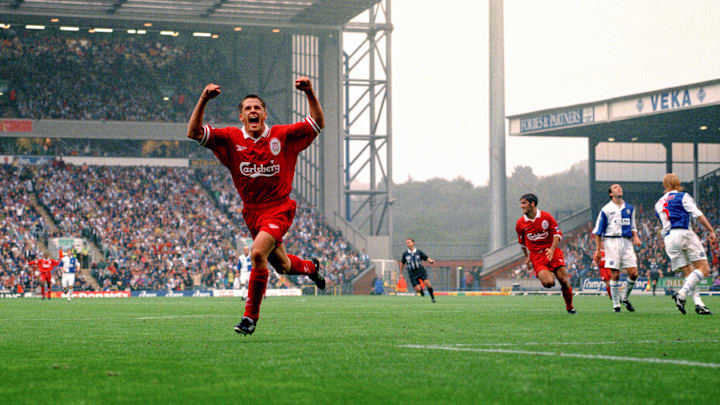
When it comes to the most prolific strikers to pull on a red shirt, you needn’t look further than Michael Owen. A player whose career decisions definitely split opinion, but for some, he was the catalyst that opened the door to adoration of this football club.
He was the talisman, the flicker of hope to pin ourselves to. Regardless of how you view Michael Owen, what cannot be denied or questioned is his talent, a talent that you only tend to see once in a generation.
Boy Wonder
Michael James Owen was born on the wrong end of the M62 in Chester, England. Playing for England from the age of 14, he turned the heads of the biggest youth teams in the country, with Liverpool, Chelsea and Manchester United showing interest.
Whilst he didn’t put pen to paper until later, he was training with Liverpool’s youth team from the age of 16 and outshining all of the older boys in his class.
When he turned 17, he made the choice to join Liverpool full-time and commit his future to the Reds. At the time, he was Liverpool’s youngest ever goal scorer, netting against Wimbledon in his debut and going on to hit record numbers for a teenager.
That debut season saw him find the back of the net 23 times, something established and experienced strikers weren’t getting close to. People had no choice but to stand up and take notice, and as more eyes watched him, the better he grew.
After representing England at every level and on the back of this glorious season, he got his big call-up to the senior team for the 1998 World Cup.
The Argentine Assault
In a squad that was pipped to have a deep tournament run with strikers like Shearer, Sheringham and club team mate, Robbie Fowler, Owen found himself starting at the World Cup at 18 years old.
He’d proven time and time again that his age wasn’t an issue, and what he did under the lights in Saint-Ettienne certainly proved that.
After getting through the group stage, we faced an old enemy in Argentina, and what we saw was a World Cup classic. It had everything: drama, red cards, plenty of goals and a penalty shootout.

However, the biggest event of the evening was brought by Michael Owen. England had just equalised from the spot, and the tide had begun to turn in their favour.
Owen picked the ball up on the halfway line, and with the world watching, he had only one thought. He sets off at the Argentine defence and shows no sign of slowing. They retreated further and further back, he keeps progressing.
A shoulder feint here, a touch out wide there, he’s managed to surpass the entire back line and fires a rocket past the helpless Carlos Roa into the far left corner. To this day, it still remains one of the greatest goals in World Cup history.
England went on to lose the game, but that moment will never be forgotten. As a boy growing up in England, the next day, everyone down the park was trying to replicate what Owen had done. I’m not ashamed to say I’ve tried it in my adulthood too.
The Turning Point
Owen was flying. He didn’t look like he could be stopped by anything or anyone. Fast forward to the following season. Liverpool are away at Elland Road playing Leeds United.
There are certain canon moments you remember in football growing up, and for this, this one is extremely vivid. Owen, using the pace he was renowned for, sets off down the line to push Liverpool forward.
Suddenly, his leg buckles, and he comes to a full halt on the floor by the sideline. Medical staff come on, Owen goes off, the game continues.
What happened next, by Owen’s own admission, changed his career forever. He had ruptured his hamstring and was out for 5 months.
That pacey, direct, and fierce youngster had been given his first setback, and unfortunately, he was never able to fully recover.
In interviews, he’s said that altered how he needed to play. He needed to be more technical than explosive. He’s gone on record saying that from the age of 23, he knew he’d begun to decline as a top-level player.
At a time when strikers hit their prime, Owen was capped. We can only guess the heights he would have reached both for himself and for Liverpool, but he still had time to leave his mark on European and domestic football.
Trophies: Club & Personal
2001 was some year for Liverpool Football Club. There had been a pretty severe power switch in English football as it saw us move to the back of the line with Manchester United and Arsenal replacing us as the top dogs.
We were a ‘let’s just try and get top 4’ team, sometimes even missing out on that, but 2001 gave us all something to cheer about. We’d managed to make 3 finals that year. The League Cup, the FA Cup, and the UEFA Cup (now known as the Europa League).
Owen had recovered from his injury, but he wasn’t hitting the same minutes as his teenage years. That didn’t stop him from getting in on the goals, though.

He found the net 24 times across all competitions, and whilst he was a key performer in all finals, he did his best work at Wembley against Arsenal in the FA Cup final.
When people think of Michael Owen in the Liverpool shirt, there’s a high chance they’ll think of this game. He single-handedly pulled victory from the jaws of defeat, scoring twice in the last 10 minutes to hand the title to Liverpool.
That was the 2nd trophy in our eventual treble, and performances like that don’t go unnoticed, especially by European governing bodies of football.
Owen remains to this day Liverpool's only winner of the Ballon d’Or trophy, which he picked up in 2001. A fitting tribute to a young man who’d come through significant adversity to claim the biggest individual prize a professional footballer is capable of.
Whatever happened after that is up for debate, but what can’t be denied is the level of performance and commitment shown to the Red shirt to get into that position. The position of Europe’s best could well have been repeated for years to come.
Real Madrid & others
A few years later, in the summer of 2004, Owen decided his time at Liverpool was up. He’d hit 28+ goals in each season since his Ballon D’Or win, but when Real Madrid comes knocking, there is usually only one outcome.
Owen left for £8 million and never fully found his feet anywhere after that. He spent one year in Madrid, always battling with the superstars they had on show.
He struggled to maintain a steady place in the starting eleven. Even though he found the net 16 times, he found himself back in England the following season.
He found a little bit of form at Newcastle alongside Alan Shearer, but then it get's a little dicey. It’s almost an unwritten rule that you never defect to United if you’ve ever played for Liverpool, but Owen did exactly that.
Was I livid when I found out? Yes. Did I curse his name at every opportunity? Yes. Did I eventually grow up and appreciate all he’d done for Liverpool and his country despite his setbacks? Yes.
Whether you loved him, hated him, or found yourself on the fence, what can’t be denied is his ability. It had been decades since we’d seen anything like Michael Owen, and we can only guess how high his ceiling could have been.
It can be hard to know exactly when you reached the point of no return as a Liverpool fan, but when I look back at my own journey, Michael Owen is in the majority, if not all, of those moments.
Liverpool Lore will return next Thursday.
 Add us as a preferred source on Google