

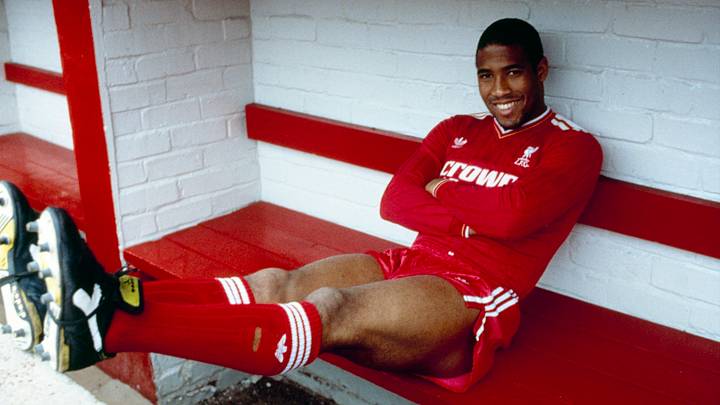
John Barnes was a technically gifted, pacey and devastating winger. Emerging toward the end of Liverpool’s UK dominance, he’s regarded by a generation as the best attacker to play in Red.
In a time where superstars were ten a penny in the Liverpool squad, with names like Ian Rush, Kenny Dalglish and Alan Hansen, Barnes regularly outshone them all and was one of the few players to do it for England as well.
John Barnes, Liverpool legend
John Barnes joined Liverpool in 1987, quite a time to join Liverpool, really. We were still enjoying our period of prolonged success, which had lasted a couple of decades at that point.
We were the best team, consistently, in the country, and most Liverpool fans hadn’t seen it any other way.
Back then, we didn’t have the obsession with wingers as we do now, so in that respect, Barnes was a bit of an anomaly. It was a time when the ‘number 10’ was always the standout attacker.
It’s extremely obvious to see why, though. Maradona, Zico, Baggio. When teams achieved that kind of success, it usually trickles down to others.
These days, the 4-3-3 is used by almost everyone, having the number 10 as your focal point in the 80s was the same thing.
Barnes crafted his own position and honed his talents until people had to take notice. It was unheard of for your left midfielder to be joining every attack, never mind driving at the defence every chance he got.

During his 10 years at the club, he amassed a whopping 406 appearances, putting him 25th in our all-time list. Whilst that might not seem quite high, we’re a club built on loyalty and holding onto our own. For Barnes to give us a decade of service is extremely commendable.
His career at Liverpool was one of adaptability and commitment. He started off as this enigma.
He reinvented the left midfielder role to devastating effect. He’d be rocking up goal involvement numbers higher than some of the attackers, and defenses didn’t know what to do with him.
He’d pride himself on his ability to get past a man. His small deft touches would see him gliding through defenses week in, week out, and he formed a sensational partnership with Liverpool’s record goalscorer, Ian Rush.
For nine years at Liverpool, those two formed an electric partnership. The synergy they showed was dazzling and devastated opposing teams. Whilst Dalglish was Rush’s main provider, and naturally so, Barnes chipped in for 27 assists to our all-timer. Numbers not to be sniffed at.
Collecting 8 trophies during his time at Anfield and being pivotal to that success will keep him in high regard forever.
There is a reason why John Barnes consistently makes Liverpool all-time XI’s and not just from the fans, either.
Liverpool and football legends regularly praise Barnes’ abilities and playstyle. Gary Lineker has gone on record as saying that he has ‘something Brazilian’ in him. Potentially the highest praise you could have been given at the time in football.
Jamie Carragher is never shy about proclaiming Barnes as one of his favourite players of all-time, a player he grew up worshipping. Rush, Dalglish, Beardsley. All are quick to answer the question of ‘just how good was John Barnes?’
There is no smoke without fire, and if your elite peers all have the same notion, the chances are that there is some truth there.
But it wasn’t just in the Red of Liverpool where Barnes shone. He did it for his country, too.
John Barnes shined for England
Born in Kingston, Jamaica, Barnes moved to England when he was 12 years old. 5 years later, he’d join Watford and the rest is history.
Whilst it wasn’t long before Liverpool came knocking, it wasn’t too long before his nation followed suit and did the same.
At that time in British football, if you had a British passport, you could play for either of the Home Nations, even with no blood ties to the nation.
He’s gone on record to say that had Scotland asked first, he’d have played for Scotland. Luckily for me and the rest of England, they didn’t.

Barnes was a regular in England squads, long before he ever pulled on a Liverpool shirt. But this was a difficult time for black players on the world stage of football.
Barnes would regularly be subjected to racist remarks and comments from the opposing team and sometimes his own. He and other black England players, like Mark Chamberlain, were often subject to racist comments after games.
In 1984, Barnes scored the 2nd goal in a 2-0 win over Brazil in a friendly in Brazil. It was one of the most beautiful goals of the era. He picks the ball up on his trusty left-hand side and sets off at the Brazilian defence.
He walks the ball past 4 or 5 stationary defenders who can’t land a glove on Barnes. He then casually and calmly slots it past the keeper, leaving the stadium in disbelief.
One of England’s greatest goals, soon to be marred by comments of certain groups of English fans saying that the goal didn’t count, as it was scored by Barnes, and therefore the result was 1-0.
For a man to give everything for the country he’s representing and to do it at such a high level for so long, it’s almost criminal for the person not to be lauded and praised for every positive move he makes in that shirt.
Luckily, Barnes’ actions would always echo louder than their words, and he’d continue to put in elite performance after elite performance.

Whilst the England system didn’t fully suit him at times, he still racked up 79 appearances and scored 10 times for his country. Nothing quite like letting your ability talk for you and silence the negativity.
So here we are, on the brink of another England foray in the greatest football spectacle on earth. Some England fans will recap Barnes' performances on the pitch at major tournaments during this time and rightly so.
Others will be rapping along with Barnes’ verse in the New Order World Cup song from 1990, World in Motion. Almost a right of passage for any England supporter to know off by heart.
Today, England’s latest batch of talent put themselves in the fighting line of the British media to try and bring home England’s first major trophy since 1966.
Whilst we need to hold and give, but do it at the right time, there will no doubt be some moments that we’ll be talking about for years to come. I’m just hoping they’re positive ones.
Liverpool Lore will return next Thursday with another installment.
 Add us as a preferred source on Google