

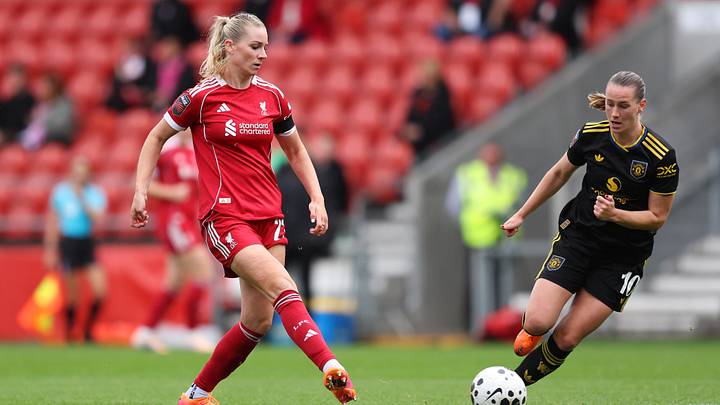
Liverpool Women are almost back in action. After finishing second-bottom of the Women's Super League last season, only spared relegation because Leicester were hopeless, fair to say Gareth Taylor's team are targeting much better this time round. They kick off the new WSL season against Charlton Athletic at the Valley on the first weekend on September.
Meantime, the Reds did reach last season's FA Cup semi-finals, heartbreakingly beaten 3-2 by Brighton & Hove Albion, despite leading 2-0 early on at BrewDog Stadium.
Nevertheless, this has given players, coaching staff and supporters alike a taste for a cup run. Well, the new-look, revamped Subway Players Cup could present Liverpool with a fantastic opportunity to win a piece of major silverware for the very first time.
We'll document why, and the competition's new, somewhat convoluted, format in just a second, but first Liverpool learnt their six league phase fixtures on Thursday, as documented below.
Liverpool Subway Players Cup league phase fixture list
Our Subway Players Cup League Phase fixtures have now been confirmed 🏆
— Liverpool FC Women (@LiverpoolFCW) August 6, 2026
- Wednesday 23 September: Sunderland - St Helens Stadium. Kick off 7pm.
- Wednesday 30 September: Birmingham City - St Andrew's. Kick off 7pm.
- Wednesday 21 October: Manchester United - St Helens Stadium. Kick off 7pm.
- Wednesday 11 November: Aston Villa - St Helens Stadium. Kick off 7pm.
- Wednesday 18 November: Nottingham Forest - City Ground. Kick off 7pm.
- Wednesday 16 December: Burnley - The County Ground. Kick off 7pm.
Note: All venues, dates and kick-off times are currently subject to change.
The two fixtures that jump off the page are the two in the middle. Fierce rivals Manchester United finished fourth in the WSL last season, while Aston Villa came ninth, albeit they are one of the division's most ambitious clubs. It is probably good news for Taylor's team that both of these matches are at home in St Helens.
The Reds will also meet a trio of WSL2 clubs, namely Sunderland, Nottingham Forest and Burnley, adding a bit of variety of their calendar. Thus, Liverpool should accrue more than enough points to reach the knockout stages, but how does the tournament, once known as the Conti Cup, now work?
Subway Players Cup format
23 Women's Super League and WSL2 clubs will enter the league phase. They are divided into north and south to reduce travel costs in terms of their fixture lists, albeit everyone is placed in one gigantic league table.
Subway Players Cup regional split
- Northern: Aston Villa, Birmingham, Burnley, Durham, Everton, Liverpool, Manchester United, Newcastle, Nottingham Forest, Sheffield United & Sunderland.
- Southern: Brighton, Bristol City, Charlton, Crystal Palace, Ipswich, Leicester, London City Lionesses, Southampton, Tottenham, Watford, West Ham & Wolves.
Every club will place six matches, three at home and three away, against six different opponents. After that, the top eight sides progress, with it being a straight knockout competition thereafter using a seeding system.
- Quarter-final match-ups: 1st vs 8th, 2nd vs 7th, 3rd vs 6th & 4th vs 5th.
The quarter-finals will take place in January and the semis in February, with the final on 13 or 14 March at a neutral venue that is yet to be announced. So, why should Liverpool take this competition so seriously?
Why the Subway Players Cup should be a priority for Liverpool
For the first time ever, the League Cup will not feature England's UEFA competition representatives. Thus, last season's top three in the WSL, Manchester City, Arsenal and Chelsea, are not featuring in the Subway Players Cup, which really opens it up for the rest of the field.
Between them, those three clubs have won all 15 editions of the League Cup since the tournament's inception in 2011. On top of this, one of the triopoly have won each of the last 11 WSL titles, dating back to Liverpool's most-recent triumph in 2014. Meantime, they have also been FA Cup winners in 13 of the last 14 seasons, with Manchester United's triumph over Tottenham in 2024 the sole exception.
Thus, outside of Man City, Chelsea and Arsenal, it has been practically impossible for anyone else to collect major silverware in England for over a decade. Well, that is no longer the case, with Liverpool among many aspiring clubs, just outside the establishment, who should seriously target success in the Subway Players Cup.
 Add us as a preferred source on Google